A few years ago, getting on page one of Google was the whole game. Today, more and more of your buyers skip the results page completely. They open ChatGPT, Gemini or Perplexity, describe what they need, and ask for a shortlist. The AI names three to five brands, and that shortlist is often where the buying decision starts.
The scale is hard to ignore. ChatGPT passed 900 million weekly users in early 2026, and at Google I/O 2026 Sundar Pichai said AI Overviews now have over 2.5 billion monthly users, with AI Mode passing 1 billion. If your brand is missing from those answers, you are invisible at the exact moment someone is ready to choose.
I run AI search and GEO (Generative Engine Optimization) projects for brands every week at RankTix. In this guide, I’ll show you how to get your brand recommended by ChatGPT, Gemini and Perplexity in 2027, using the exact process we use for clients, so you can start on it today.
In this guide:
- Real example: what ChatGPT recommends
- How AI assistants decide which brands to recommend
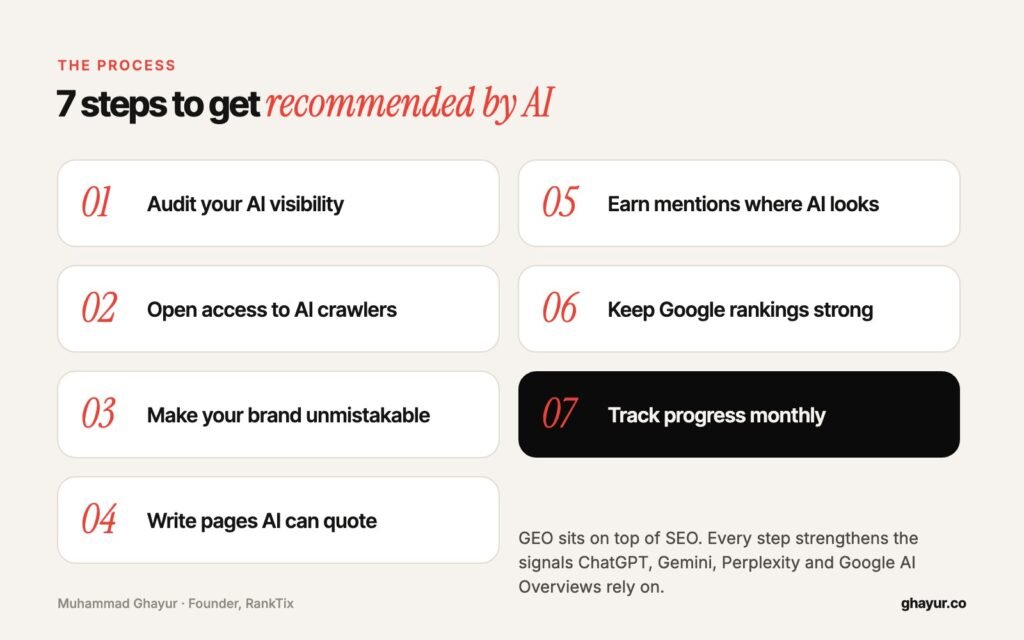
- The 7-step process
- Common mistakes to avoid
- How long it takes
- FAQs
Key takeaways
- AI assistants recommend brands they can clearly identify, that are described consistently, and that trusted sources already talk about.
- In Ahrefs’ study of 75,000 brands, branded web mentions had the strongest link to AI Overview visibility (0.664), far ahead of backlinks (0.218).
- Before anything else, make sure AI crawlers can reach your site. To appear in ChatGPT search,
OAI-SearchBotmust be allowed. - Pages that answer questions directly, with clear facts, comparisons and FAQs, are the easiest for AI to quote.
- Strong Google rankings still matter, because AI answers lean heavily on pages that already rank and are trusted.
- Track a fixed set of buyer prompts every month. AI answers change by person, prompt and day, so measure trends, not single screenshots.
Real example: what ChatGPT recommends for “best physiotherapist in London”
Before the theory, here is what this looks like in practice. We asked ChatGPT a question patients type every day: “Best physiotherapist in London.” It did not return ten blue links. It named three clinics, in order, with a reason for each one.
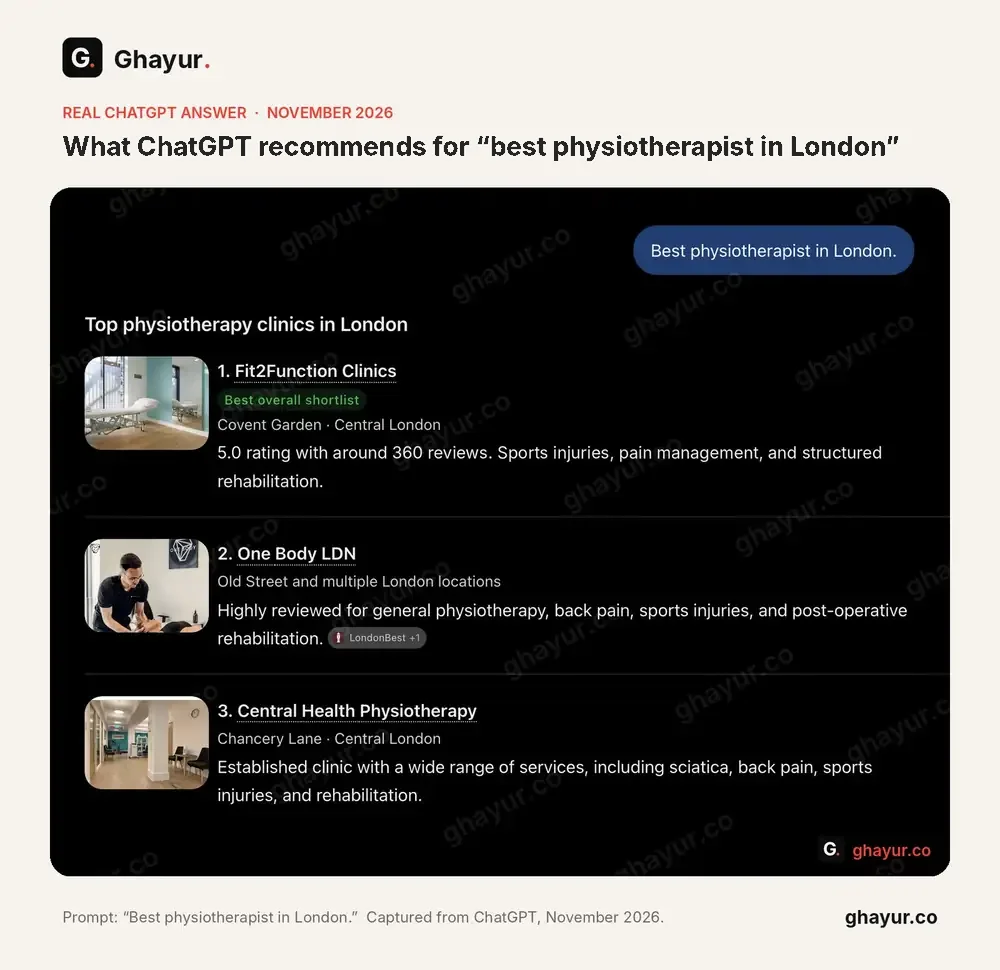
Look at what ChatGPT says about each clinic: a clear location, a review count and the specific problems they treat. That is not luck. Each one is easy to identify, described the same way across the web, backed by hundreds of reviews and mentioned on sources the AI already trusts. Those are exactly the signals the steps below help you build, and it is the same playbook we use to get brands into answers like this one.
How AI assistants decide which brands to recommend
When someone asks an AI assistant for a recommendation, it does two things. First, it looks for information: either from what it learned in training, or by searching the web live and reading a handful of pages. Then it writes a summary, naming the brands that appear most often and most credibly in what it found.
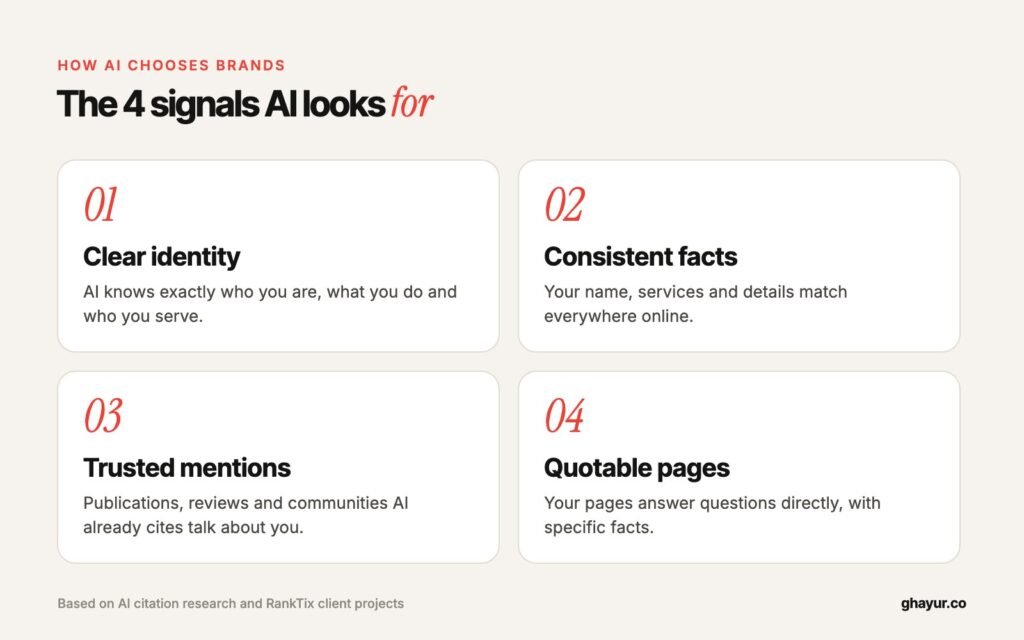
That means the AI is not choosing at random. It favours brands that are:
- Clearly identifiable. It knows exactly who you are, what you do and who you serve.
- Described consistently. Your website, profiles, directories and press all tell the same story.
- Mentioned by sources it already trusts. Industry publications, review sites, Wikipedia, Reddit and YouTube show up again and again in AI citations.
- Easy to quote. Your pages answer the question directly instead of hiding the answer under marketing copy.
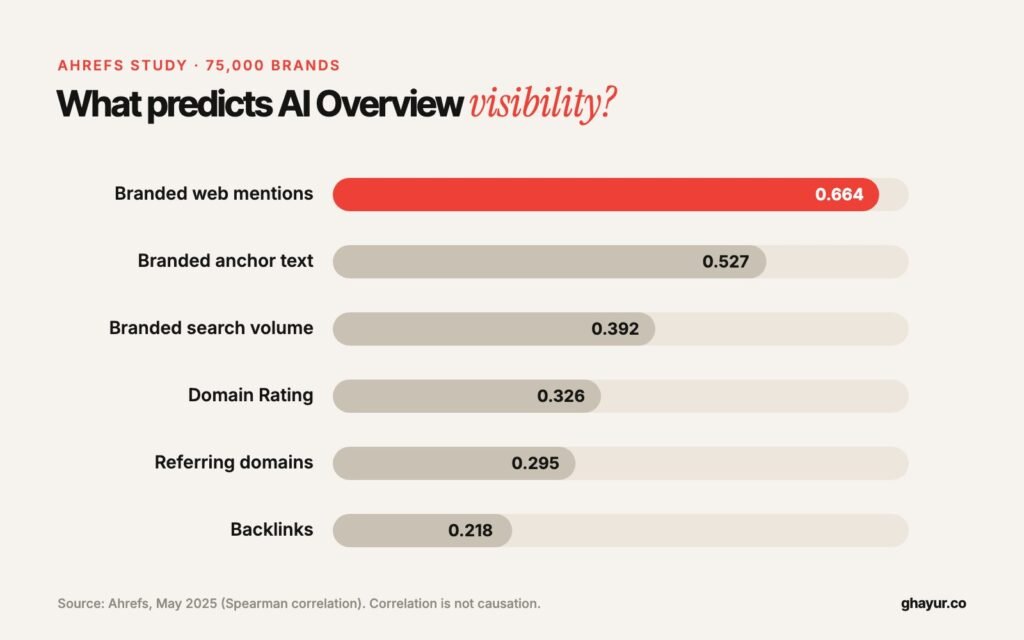
The data backs this up. In Ahrefs’ analysis of 75,000 brands, the factor most closely linked to appearing in Google’s AI Overviews was the number of times a brand is mentioned across the web:
| Factor | Correlation with AI Overview visibility |
|---|---|
| Branded web mentions | 0.664 |
| Branded anchor text | 0.527 |
| Branded search volume | 0.392 |
| Domain Rating | 0.326 |
| Referring domains | 0.295 |
| Backlinks | 0.218 |
Where those mentions live matters too. OtterlyAI’s study of over a million AI citations found Reddit, Wikipedia and Forbes among the most cited domains across ChatGPT, Perplexity and AI Overviews, with Perplexity leaning hardest on community discussions. Each platform has its own habits, so a good strategy covers several kinds of sources, not just your own website.
Step 1: Find out where you stand today
You can’t improve what you haven’t measured. Start with an AI visibility audit:
- Write down 20 to 30 questions your buyers actually ask before they buy. Think “best [service] for [type of business]”, “[your brand] vs [competitor]”, “is [your brand] good for…” and “how do I choose a [product]”.
- Run each prompt in ChatGPT, Gemini, Perplexity and Google (AI Overviews and AI Mode).
- Record which brands are named, in what order, and which web pages are cited as sources.
- Note where you appear, where competitors appear instead, and which third-party sites keep coming up.
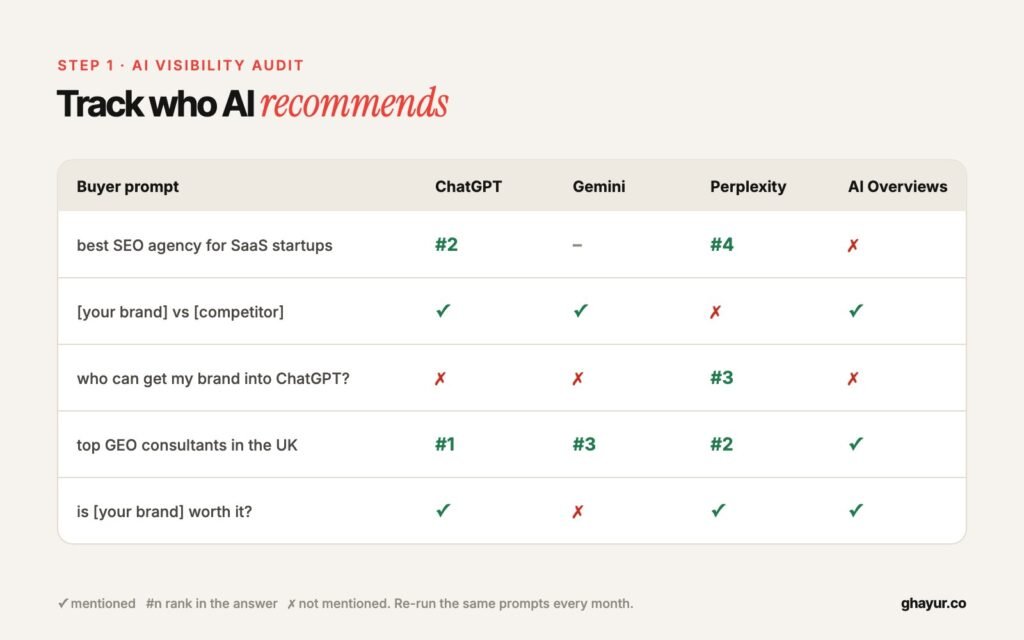
That last column is gold. The sites the AI cites for your topic are the sites you need to be mentioned on.
Step 2: Make sure AI crawlers can reach your site
This is the most common problem I find, and the easiest to fix. Many sites block AI crawlers by accident, through an old robots.txt rule, a security plugin or a firewall setting.
According to OpenAI’s documentation, the crawler that decides whether you can appear in ChatGPT search is OAI-SearchBot. GPTBot is separate and only relates to model training, so you can block training while still allowing search. For Google’s AI Overviews and AI Mode, normal Googlebot crawling and indexing is what counts.
A simple robots.txt that keeps you visible in AI search looks like this:
User-agent: OAI-SearchBot
Allow: /

User-agent: PerplexityBot
Allow: /

User-agent: Googlebot
Allow: /

Sitemap: https://www.yoursite.com/sitemap_index.xml
Also check that your key content is visible without JavaScript. Some AI crawlers don’t render scripts well, so text that only appears after a script runs may never be read.
Step 3: Make your brand unmistakable
AI tools build an understanding of your brand as an “entity”: a thing with a name, a category, a location, founders and relationships. The clearer and more consistent that picture is, the more confidently an AI will recommend you.
- Use one consistent brand name and one-line description everywhere: website, LinkedIn, Google Business Profile, directories and social profiles.
- Have a strong About page that states what you do, who you serve, where you are based and who runs the company.
- Add Organization (or Person) schema with
sameAslinks to your official profiles. - Keep facts like founding year, team size, services and locations identical across the web. Conflicting facts make AI hesitate.
Step 4: Write pages AI can quote
AI assistants lift clear, self-contained answers. Pages that bury the answer under long introductions rarely get cited. When you write or update key pages:
- Answer first. Put a direct, one or two sentence answer right under each heading.
- Use specifics. Real numbers, prices, timelines and named examples are far more quotable than vague claims.
- Add comparisons and tables. “X vs Y” pages and comparison tables are some of the most cited formats.
- Include FAQs that match the questions from your Step 1 audit.
- Show who wrote it. A real author with real experience, and a visible “last updated” date, builds trust with readers and machines.
Step 5: Earn mentions where AI already looks
This is where most of the work, and most of the results, sit. Go back to the sources the AI cited in your audit and work out how to earn a genuine place on them:
- Industry publications and “best of” lists in your niche.
- Review platforms such as G2, Clutch, Trustpilot or Google reviews, depending on your industry.
- Communities like Reddit and Quora, where you take part genuinely and helpfully, never with spam.
- YouTube, podcasts and LinkedIn, which are increasingly cited and help you build a recognisable expert voice.
- Digital PR: original data, expert commentary and stories that journalists want to cover.
Links still help, but in AI search the conversation about your brand matters more than the number of links pointing at it.
Step 6: Keep your Google rankings strong
GEO doesn’t replace SEO. It sits on top of it. AI Overviews and AI Mode draw on Google’s own index, and pages that already rank well are far more likely to be used as sources. Technical health, strong on-page SEO and quality backlinks are still the foundation. In my experience, brands that ignore classic SEO and chase AI tricks rarely see lasting results. You can see what the combined approach looks like in my recent client results.
Step 7: Track your progress every month
AI answers change from person to person and day to day, so a single screenshot proves nothing. Instead:
- Re-run the same set of prompts every month and track how often you are mentioned (your share of voice).
- Track which of your pages get cited, and which competitor pages get cited instead.
- In GA4, watch referral traffic from chatgpt.com, perplexity.ai and gemini.google.com.
- In Search Console, watch branded search growth, which tends to rise as AI mentions increase.
Common mistakes to avoid
- Blocking AI crawlers by accident through a firewall, CDN or security plugin.
- Publishing large amounts of thin, AI-generated content that says nothing new.
- Inconsistent brand facts across your site and profiles.
- Spamming Reddit or review sites, which damages trust and can get you banned.
- Judging results from one prompt on one day.
How long does it take?
Technical fixes like crawler access can make a difference within weeks. Building enough mentions and authority to be recommended consistently usually takes three to six months, depending on your market and starting point. Nobody can honestly guarantee that an AI will recommend you for a given prompt. What you can do is steadily improve the signals AI relies on, and measure the change month by month.
FAQs
Can I pay to get my brand recommended by ChatGPT?
No. There is no way to pay for an organic recommendation in an AI answer. Recommendations come from the information the AI finds and trusts, which is exactly what GEO works on.
Is GEO different from SEO?
They overlap heavily. SEO helps you rank in search results; GEO helps you get named and cited inside AI-generated answers. Good GEO is built on good SEO, plus extra focus on brand mentions, entity clarity and quotable content.
Do I need an llms.txt file?
It’s optional. None of the major AI search providers has confirmed that they rely on it, so it shouldn’t come before crawler access, content quality and brand mentions.
Which AI platform should I focus on first?
Start where your buyers are. For most businesses that means ChatGPT and Google’s AI Overviews, because of their reach. The steps in this guide help across every platform, since they all reward the same core signals.
Want to know where your brand stands?
Try it now: ask ChatGPT the question your best customer asks before buying, and see who it recommends. If it isn’t you, book a free 30-minute strategy call. I’ll run your key prompts live, show you which sources the AI is using, and tell you exactly what I’d fix first. You can also see how we work in our AI visibility packages, or read more about me and my team.